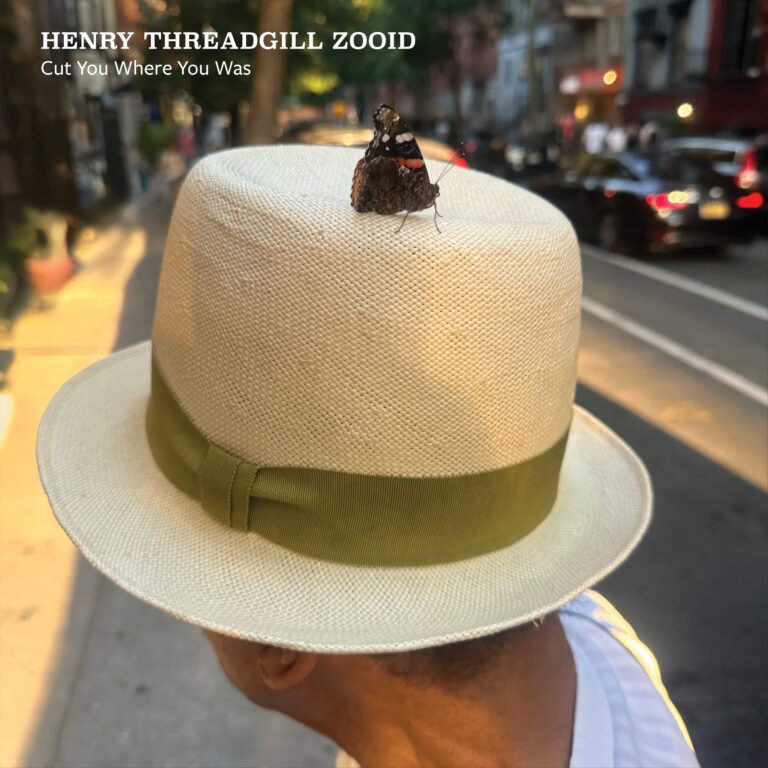
Cut You Where You Was
Henry Threadgill
Track List
- Fluoroscope
- 6:12
- Bingo Part 1
- 2:16
- Bingo Part 2
- 2:03
- Bingo Part 3
- 3:42
- Red Admiral Red Moon Rising
- 12:21
- Blur
- 1:46
- Off and On What Happened
- 1:53
- Lightnin'
- 1:48
- Snow Bones
- 1:56
- Wind at My Back
- 1:55
Cut You Where You Was finds composer, saxophonist, and flutist Henry Threadgill returning to his flagship band Zooid, the ensemble that – for over a quarter century – has been the central laboratory for many of his most consequential musical explorations. It is the longest-running working group of his remarkable career, whose work won him the 2016 Pulitzer Prize for Music for their album In for a Penny, In for a Pound. The new work is their first release since 2021’s Poof, which according to Downbeat “visits strange territories, upsets our sense of scale and value but delivers whole new musical worlds.” The band’s personnel remains committed to their collective purpose: original members Liberty Ellman on guitar and Jose Davila on tuba and trombone, Elliot Humberto Kavee on drums almost since the beginning, and cellist Christopher Hoffman for over 15 years, with Threadgill on alto saxophone and flutes. These are musicians who have devoted years not simply to performing this music but to learning how to think inside it – how to negotiate structures that shift beneath their feet, where every decision alters the balance of the whole. They are a rare example of an ensemble whose longevity has never produced routine. Instead, it has produced a level of collective fluency that allows Threadgill’s music to become increasingly elastic, unpredictable, and alive.
For over six decades, Threadgill has constructed one of the most individual bodies of work in contemporary music, developing a compositional language that resists stylistic categories while continually expanding its own internal logic. While he has led such illustrious groups as Air, Sextett, Very Very Circus, and Make a Move, in the 21st Century, it has been Zooid that has been his primary muse for the development of his music, including his interval-based compositional system, an approach that reimagines harmonic relationships while granting unusual freedom to the performers navigating them. There is something quietly radical about the persistence of this ensemble: In an era defined by projects assembled for singular moments, Zooid represents the opposite philosophy: long-term allegiance as artistic necessity. Their name –taken from the biological term for an individual animal that connected to others to form a single organism – is more apt today than ever. Listening to Zooid can feel like observing a living organism continually reorganizing itself. Their roles are non-hierarchical, with each musician sharing melodic, harmonic, rhythmic and architectural functions. Individual lines retain complete independence while somehow contributing to an unmistakable collective momentum.
Threadgill speaks of the band with a mixture of admiration and gratitude: “This is music that requires real commitment. You won’t even be able to play it if you aren’t putting in 100 percent. Everyone is now playing at such a high level and doing it with such ease that the music almost sounds like a conversation. There is real telepathy going on.” Still, no one ever truly
masters this music. The pieces are designed to remain unstable and elusive, demanding perpetual recalculation from everyone involved. The score provides a framework, but realization belongs to musicians capable of hearing multiple possibilities simultaneously. Zooid has become precisely that kind of ensemble: one whose virtuosity lies less in execution than in collective perception and an expansion of the music’s capacity for greater risk taking.
At its center remains Threadgill himself – not as conductor or featured soloist, but as equal participant, instigator, and continual source of surprise. One continues to hear him as an improviser of uncommon urgency. His alto saxophone retains its unmistakable vocal quality: a sound capable of carrying the grain of the blues, fragments of gospel testimony, sudden humor, deep lyricism, and startling abstraction within the same breath. His flute playing opens entirely different dimensions of color and space, often redirecting the ensemble’s trajectory with remarkable economy.
The album’s compositions find Threadgill furthering the rhythmic convolution that has long been an important aspect of his music through the use of varying meters. It’s a testament to Zooid’s mastery of the language that – despite the overlapping rhythms rarely settling into any obvious patterns – the music is propelled forward with impetus and its own off-kiltered swing. Also of note is the preponderance of brief pieces, each around two minutes in length. These are inspired by Threadgill’s fascination with early recording technologies, in particular the phonograph cylinder, also known as Edison cylinders, which were the earliest widely-distributed medium for reproducing sound recordings. Their short recording durations force each musician to make their statements quickly. According to Threadgill: “You can’t take your time to get to the point because there won’t be a second chorus. There are only a few bars of music, so you better be ready to go.” At a time when a lot of music can be discursive in their protraction, this enforced time constraint creates an entirely different modality for musical expression.
Cut You Where You Was marks 25 years since the release of Zooid’s first album Up Popped the Two Lips, which – along with the release of Everybodys Mouth’s a Book from Make a Move – were the inaugural releases on Pi Recordings. Indeed, the label was founded with the impetus of documenting new releases from Threadgill. As the label celebrate its 25th anniversary this year, we can’t help but reflect on our journey, always with Threadgill as our lodestar. Across thirteen distinctive releases, we’ve been there to document the vast majority of his recorded work in the 21st century. He continues to astonish us at the age of 82 with his restless push for creativity and invention. With this new release and the album Fifteen – his collaborative trio with pianist Vijay Iyer and drummer Dafnis Prieto out on Nonesuch Records – he proves that his playing is still at the highest level. He also continues to expand the scope of his artistic expression with work in photography, visual arts and multimedia. His memoir Easily Slip Into Another World, written with Brent Hayes Edwards, is out in a new paperback edition on Vintage Books (Knopf Doubleday).
Cut You Where You Was arrives as further evidence that Threadgill’s compositional imagination remains in constant motion. Zooid’s music refuses stasis because it refuses certainty. It asks musicians to listen beyond habit, audiences to hear beyond expectation, and both to participate in a form of thinking that remains, even now, unlike anything else in contemporary music.