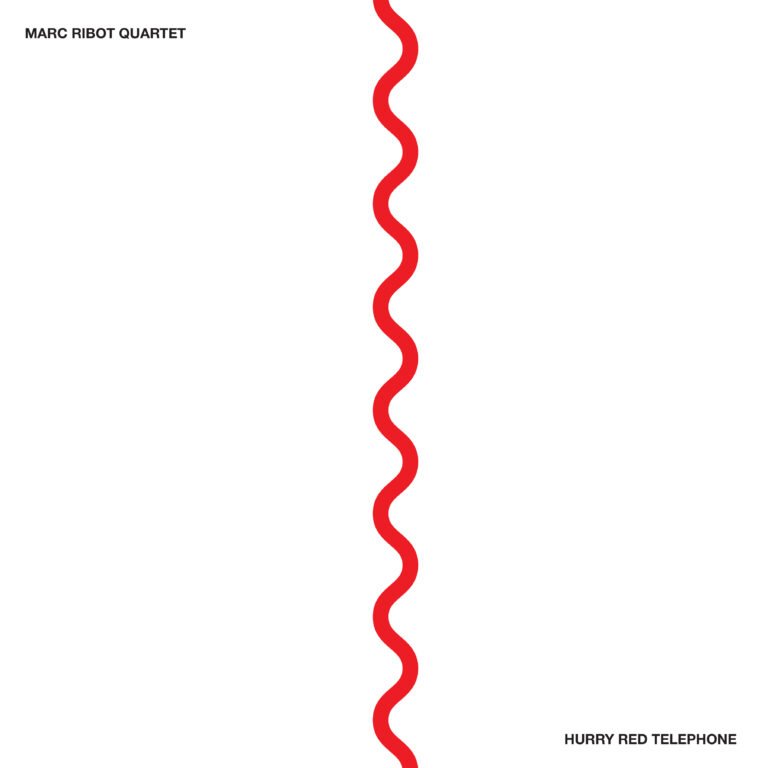
Hurry Red Telephone
Marc Ribot
- Marc Ribot – Guitar
- Chad Taylor – Drums
- Briggan Krauss – Alto Saxophone
- James Brandon Lewis – Tenor Saxophone
- Brian Settles – Tenor Saxophone
- Hilliard Greene – Bass
- Sebastian Steinberg – Bass
Track List
- New Monster
- 14:57
- Faucets of Terrible
- 4:59
- Gnat
- 5:35
- Ghost of Sleeping
- 6:37
- Nan Guinan
- 6:18
- Rara
- 5:36
For more than four decades, guitarist Marc Ribot has made a career out of refusing to stay in one place, moving restlessly between jazz, rock, No Wave, singer/songwriter, solo guitar, music for film, Cuban music, and free improvisation, all while leaving an unmistakable imprint on everything he touches. With Hurry Red Telephone, Ribot returns with his first all-instrumental album since 2014’s highly-lauded Live at the Village Vanguard, which featured drummer Chad Taylor and the late bassist Henry Grimes. It reunites him with Taylor in an eponymously-named band recorded over two separate sessions: one with tenor saxophonists James Brandon Lewis and Brian Settles with bassists Hilliard Greene; and another with alto saxophonist Briggan Krauss and bassist Sebastian Steinberg. Featuring four original compositions by Ribot alongside two by Haitian guitarist and composer Frantz Casséus – Ribot’s guitar teacher and an enduring musical influence – the performances reveal all of Ribot’s best qualities, by turns volatile, lyrical, abrasive, humorous, and soulful.
Hurry Red Telephone took shape after a period of uncertainty following Grimes’s death. “The original impetus for this project was my desire to continue the trajectory that my trio with Henry and Chad had begun before Henry was forced into retirement,” Ribot explains. “The last gigs we did together were the best music I’ve ever participated in in my life. It took a while to find a way to start again after Henry died.” Ribot resists any easy description of what Grimes brought to his music. “I can’t define in words what he did,” he says. “All I know is that his playing was a catalyst to every ensemble he participated in, knocking everyone out of whatever preconceived orbits they were stuck in, dissolving every cliché with the completely unexpected, and yet managing to groove in a deep – although not always obvious – way.”
Taylor became the essential throughline. Ribot describes him as not only a great drummer but “one of the deepest listeners I’ve ever worked with,” pointing to the rapport they first developed in the group Spiritual Unity (Pi 2005) with Grimes and trumpeter Roy Campbell. That history matters on Hurry Red Telephone: Taylor doesn’t simply keep time. He anticipates, provokes, absorbs and redirects, making the quartet feel less like a fixed configuration than an ongoing conversation.
The album documents two complementary versions of that conversation. One brings together Taylor, Steinberg and Krauss. Ribot and Steinberg have a history that reaches back to the early 1990s when they toured and recorded together in Ribot’s Shrek and other projects, before Steinberg moved to Los Angeles and became a first-call for the likes of Fiona Apple, Neko Case, Iron & Wine, Phoebe Bridgers, and many others. Like Taylor, Steinberg is an intuitive player with an unusually developed sense of musical timing. Krauss – who comes out of the same Downtown creative music scene as Ribot and is perhaps best known as a member of Steven Bernstein’s Sex Mob – brings a sense of searching exploration. The group began developing the music on tour, where the compositions became increasingly flexible. Eventually the quartet recorded in Berlin between dates, capturing a working band rather than a newly assembled studio unit. The difference is audible. The music has the looseness of something being discovered in real time, but also the accumulated knowledge of musicians who have already learned how to listen to one another.
The other recordings come from an earlier New York studio session, with bassist Hilliard Greene and tenor saxophonists James Brandon Lewis and Brian Settles, who appear on separate tracks. Greene brings a bass sound shaped by a remarkable range of associations, from playing with the likes of Cecil Taylor and Charles Gayle on one hand, and as singer Jimmy Scott’s music director for almost 20 years on the other. Lewis – one of the most acclaimed young musicians in jazz today – brings the elemental force of his tenor, carrying the fire and physicality of the Coltrane tradition into a contemporary, post-everything setting. Washington, D.C.’s Brian Settles – who is a member of bassist Luke Stewart’s Silt Trio and bands led by trumpeter Jonathan Finlayson – approaches the music with a more understated virtuosity. There is even a bagpipe. On the opening track “New Monster,” David Watson brings an Albert Ayler-like intensity to the proceedings.
Across both sessions, Ribot’s guitar feels completely liberated. His experience outside conventional jazz shapes the quartet’s sound with the freedom of improvisation, the physicality of rock, and the discipline of jazz ensemble playing are all present. Stylistic differences are irrelevant here. What matters is the sense of risk – the feeling that the next phrase might veer the music towards something strange, dangerous, or beautiful.
Ribot’s long career has been one sustained act of restless exploration. In addition to his continued work with his post-rock avant power trio Ceramic Dog, solo performances, and recent studio work with such varied artists as Laurie Anderson, Robert Plant and Alison Krauss, Sam Smith, Grace Potter, Terri Lyne Carrington, and Gaby Moreno, he released Map of a Blue City, an album of original songs that NPR called “Beautiful… (his) ability to mix artistic exploration with plain-spoken profundity in ways that very few artists have been able to pull off.” He also published Unstrung: Rants & Stories of a Noise Guitarist (Akashic), a collection of essays that has been translated into French and Italian, with German and Japanese edition in the works
The album and band take their name from a verse from the poem “Several Tremendous” by Richard Siken, which depicts the poet’s efforts to rebuild his ability to write and speak after a stroke robbed him of both. For Ribot, the connection is less literal than intuitive. “The poem is about groping for language in the dark, trying to pull something together again from a great chaos, trying to build something after a great collapse,” he says. “He was writing about his personal stroke. I don’t know why I felt he was writing about all of us. But I do.” It also may be a metaphor for Ribot’s rekindled relationship with a musical language left behind after Grimes’s death. Hurry Red Telephone is less like a return than a renewal: A visceral, rollicking, and celebratory tour-de-force.