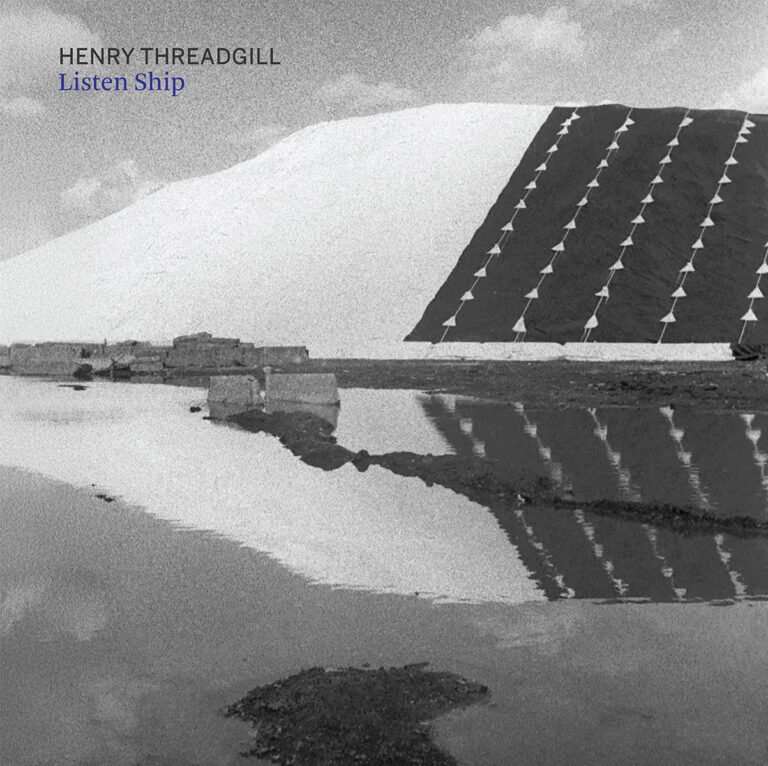
Listen Ship
Henry Threadgill
Track List
- A
- 1:11
- B
- 2:21
- C
- 1:10
- D
- 3:57
- E
- 3:34
- F
- 2:02
- G
- 1:32
- H
- 6:24
- IJ
- 1:21
- L
- 7:04
- M
- 1:56
- N
- 1:05
- O
- 0:49
- P
- 1:12
- Q
- 0:40
- R
- 7:59
Listen Ship is the latest masterwork in the ever-expanding sound world of Pulitzer Prize-winning composer Henry Threadgill, whom The New York Review of Books described as “one of American music’s great Romantics and a lifelong seeker of the sublime.” The new work is a suite for six acoustic guitars – including such individual stylists as Bill Frisell, Miles Okazaki and Brandon Ross – and two pianos that utilize Threadgill’s unique intervallic syntax to illuminate his idiosyncratic vision. The eight string instruments revel in the music’s detail with intricate gestures that entwine to form a grand statement.
Threadgill’s compositional ingenuity – now well into its sixth decade – continues to expand in scope. In recent years, he has alternated writing for and performing with his flagship band Zooid and composing for large ensembles such as for The Other One, his 14 or 15 Kestra, and Double Up Ensemble. With Listen Ship, Threadgill is revisiting a guitar and piano concept that he first explored on his 1994 album Song Out of My Trees, in particular the track “Over the River Club.” Two of the guitarists from that session – Brandon Ross and Jerome Harris on acoustic bass guitar – return here to join a band hand-picked by Threadgill to realize his unique conception: guitarists Frisell, Okazaki, Greg Belisle-Chi; bass guitarist Stomu Takeishi; and Maya Keren and Rahul Carlberg on matching Steinway grand pianos. His decision to use acoustic guitars with their rapid tonal decay – Ross on soprano, Frisell and Okazaki on archtops, Belisle-Chi on flat top, and the two in the bass register – contribute to the clarity of the fractured counterpoint and rhythmic asymmetry. According to Frisell: “Henry’s clearly thought a lot about the guitar and how the overtones of different ones vibrating together can create this beautiful kaleidoscope of sound.”
Threadgill characterizes Listen Ship as a suite with 17 distinct sections. They are arranged for various instrumental configurations and range from short gestures to longer features with more development and space for improvisation. The form shifts constantly, but taken together they create a mysteriously unified statement. The precisely choreographed orchestration highlights all of the usual characteristics of Threadgill’s music: unusual forms, unexpected timbres, and slippery counterpoint and odd-metered rhythms, all shaped by the composer’s conducting into a singular experience.
Though Threadgill doesn’t appear as a performer, he is clearly the captain of this ship. His conducting provides the rhythmic foundation, providing the piece with an elastic time feel that heave collectively through the ensemble. Frisell said “Seeing Henry up there dancing and tapping his foot made it easier to feel where the time was. You could tell from his breathing and the movement of his whole body that he was hearing and feeling all of it at every moment.”
For Okazaki, “The compositions are only roadmaps, but Henry is the one that can show you how to get around. It’s through the guided rehearsals when you really start to see the landmarks and connecting points and get a sense of the music’s totality. All of that is in his head.”
The work is a further extension of the intervallic system that Threadgill has been developing and constantly refining for the last quarter century. According to bassist Takeishi, who first played with Threadgill over 30-years ago in Make a Move and later as an original member of Zooid: “Henry has taken his system even further. Here he’s assigning different intervals to different sets of musicians. It’s so deep.” To help him get more acclimated to improvising in this system, Miles Okazaki wrote a program that generates different permutations based on the interval parameters. “You can play them correctly, but it can feel stiff if you need to think about it too much. It’s important to get comfortable enough with the system that you are able to translate the numbers into compelling musical ideas.”
For Brandon Ross: “What isn’t written is the individual insights that each player can bring to their part. It’s demanding. It’s atypical of what most musicians commonly encounter in their usual roles and ways of interacting with their particular instruments. We were all challenged to internalize and express the piece, not just play it back – a piece full of unconventional challenges and unique idiomatic sensibilities, very precisely articulated and understood by the composer, who happened to be standing in front of you. It’s a lot of fun – if one can catch the spirit of what the music is saying. What is being communicated – what’s the idea being conveyed. The syntax, the feeling, the body language of the music. I find if that can be perceived, the whole thing clarifies, comes alive, and is transporting… once you figure out exactly how to play… that note?!”
Threadgill has had a huge impact on Bill Frisell, who first saw Air perform while living in Belgium. “Seeing that knocked me out. I was at a point in my life when I was trying to figure stuff out and I was able to see how the band related to the full history of the music while pointing to the future. Then a few years later I move to New York and saw Henry with the Sextett and my brain molecules were again rearranged.” They met years later when they both worked on Hal Willner’s Charles Mingus tribute Weird Nightmare and, two years ago, eagerly agreed when Threadgill approached him about this project. “It’s the most challenging music I’ve ever played in my life. It put me back to when I first started playing guitar in the mid-60s. It’s not just dealing with the written material, which was already stretching the technical limits of what I can do, but having to improvise in a whole new harmonic language. He has really helped me open windows to help me shake up my own stuff.”
At the age of 81, Threadgill is showing no signs of slowing down. His 2023 release The Other One was named one of the Best Classical Albums of the Year by The New York Times, who described it as “Second Viennese School meets American second line parade music…. the blend of strings, woodwinds, tuba, piano and percussion conjures jazz combo and chamber music ecstasies alike.” His memoir Easily Slip Into Another World, written with Brent Hayes Edwards, was name a Best Book of the Year by The New Yorker, NPR, and The New York Times, who called it “so good a music memoir, in the serious and obstinate manner of those by Miles Davis and Gil Scott-Heron, that it belongs on a high shelf alongside them.” There has also seen renewed interest in his earlier music with Threadgill overseeing different repertory bands performing his music written for Air, Sextett, Make a Move, and Very Very Circus. Threadgill says of Listen Ship: “It’s like the universe: the more you track it the further out it goes. There is no end.” The music just another port of call on Threadgill’s ongoing voyage without a final destination.
Listen Ship was made possible by a commissioning grant from the Robert D. Bielecki Foundation